How to paginate the display of MySQL data in PHP
First published on January 18, 2009
Suppose that you have a long list of data rows stored in a MySQL database. This could be something like personal or business contacts, book entries, or blog posts. Without pagination, the display might be hard for a user to manage.
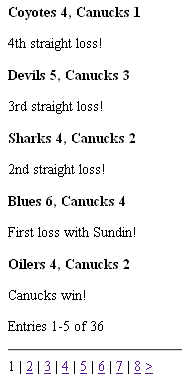
Here’s a PHP code outline to paginate the output of data to show something like this:
<?php

// How many entries you want to show per page
$perpage = 5;

// Find out what page of entries you are looking for
// The reason why you subtract 1 is so that you can calculate which returned entry (for later when we query the database) to start at
if (isset($_GET['page'])) {
    $page = max(intval($_GET['page'] - 1), 0);
    $page_original = intval($_GET['page']);
}
else {
    $page = 0;
    $page_original = 1;
}

$start_at = $page * $perpage;
$start_at_public = $start_at + 1;

mysql_connect('dbhost-typically-localhost', 'dbusername', 'dbpassword');
mysql_select_db('dbname') or die( 'Unable to select database');

// How many entries are there?
$query = 'SELECT COUNT(*) FROM `tablename`';
$result = mysql_query($query) or die('Error in query: ' . $query);
$total_entries = mysql_result($result, 0);

// You've asked for a page that is too high
if ($total_entries < $start_at_public) {
    die('Not enough entries to go that high.');
}

// Grab the specified number of entries, starting at the appropriate record
$query2 = "SELECT `title`, `content` FROM `tablename` ORDER BY `publishdate` DESC LIMIT $start_at, $perpage";
$result2 = mysql_query($query2);

// Print those entries!
while ($entries = mysql_fetch_object($result2)) {
    print '<div class="entry">' . "\n";
    print '<h2>' . $entries->title . '</h2>' . "\n";
    print '<p>' . $entries->content . '</p>' . "\n";
    print '</div>' . "\n";
}

mysql_close();

$end_value_this_page = min($start_at + $perpage, $total_entries);

if (($end_value_this_page == $total_entries) && ($start_at_public == $total_entries)) {
    print '<p>Entry ' . $end_value_this_page . ' of ' . $total_entries . '</p>' . "\n";
}

else {
    print '<p>Entries ' . ($start_at_public) . '-' . $end_value_this_page . ' of ' . $total_entries . '</p>' . "\n";
}

// How many pages of content are there?
$total_pages = ceil($total_entries / $perpage);

if ($total_pages != 1) {

    print '<hr />' . "\n";

    print '<div class="paginator">' . "\n";

    $next_link = '';
    $previous_link = '';
    $page_links = '';

    // Loop through each of the pages
    for ($page_count = 1; $page_count <= $total_pages; ++$page_count) {

        if ($page_original == $page_count) {

            // We're on this page, so no link needed
            $page_links .= $page_count;

            // Get the "previous" link if there is more than one page and if this isn't the first page
            if ($total_pages > 1 && $page_count != 1) {
                $previous_link = '<a href="?page=' . ($page_count - 1) . '"><</a> | ';
            }

            // If there are more pages than this,  prepare the "next" link
            if ($page_count != $total_pages) {
                $next_link = ' <a href="?page=' . ($page_count + 1) . '">></a>';
            }
        }

        else {
            $page_links .= '<a href="?page=' . $page_count . '">' . $page_count . '</a>';
        }

        if ($page_count != $total_pages) {
            // Print a separator for all pages but the last page
            $page_links .= ' | ';
        }
    }
    print $previous_link . $page_links . $next_link . '</div>';
}
?>
 Facebook
 Twitter
 Email this
 keung.biz. Hire my web consulting services at
  Follow us on Twitter

